Which High Frequency Concrete Vibrator Gives Strongest Compaction Effect?
Release time: 2026-06-05
Table of Contents
In the modern construction industry, the structural integrity, durability, and aesthetic finish of any concrete structure heavily rely on one critical process: consolidation. When fresh concrete is poured into formwork, it naturally contains a significant amount of entrapped air—sometimes up to 20% of its volume. If this air is not properly removed, the resulting concrete will be riddled with honeycombing, bug holes, and severe structural weaknesses. To solve this, engineers and contractors turn to mechanical vibration. Among the various tools available, finding the right high frequency concrete vibrator is paramount for achieving a dense, impermeable, and high-strength final product.
However, a common question plagues project managers and civil engineers alike: Which specific type of equipment actually gives the strongest compaction effect? To answer this definitively, we must delve into the physics of concrete rheology, the mechanics of vibration technology, and how different equipment designs interact with various concrete mix designs.
The Science of Concrete Consolidation
Before identifying the most powerful equipment, it is crucial to understand what happens to concrete during vibration. Fresh concrete is a complex mixture of cement, water, fine aggregates (sand), and coarse aggregates (gravel or crushed stone). When stationary, the internal friction between these particles causes the mixture to act somewhat like a solid, trapping large pockets of air.
When a vibratory force is applied, the rapid impulses are transmitted through the mixture. This drastically reduces the internal friction between the aggregate particles, temporarily changing the state of the concrete from a stiff mass into a flowable liquid. This process is known as liquefaction. As the concrete liquefies, gravity takes over. The heavier aggregate particles settle downwards and closer together, while the lighter entrapped air bubbles rise to the surface and escape.
To evaluate the compaction effect high frequency concrete vibrator systems provide, one must look at two primary mechanical parameters: Frequency (measured in vibrations per minute, or VPM) and Amplitude (the maximum distance the vibrating head moves from its resting position).
- Frequency is primarily responsible for moving the finer particles (sand and cement paste) and liquefying the mix.
- Amplitude is responsible for moving the heavier, coarse aggregates and determining the “radius of action” (how far the vibration reaches).
High-frequency equipment typically operates between 12,000 and 17,000 VPM. This specific range matches the natural resonant frequency of most fresh concrete mixes, making it exceptionally efficient at rapidly breaking down internal friction.
Exploring Different Types of Vibratory Equipment
There is no single “one-size-fits-all” solution in concrete consolidation. The strongest effect is often context-dependent, relying heavily on the depth of the pour, the density of the reinforcement (rebar), and the specific slump of the concrete mix. Let us examine the primary categories of equipment used in the field.
1. Internal (Poker) Vibrators
Also known as immersion vibrators, these are the most common tools used on construction sites. They consist of a vibrating head (the poker) attached to a flexible shaft, driven by a motor (electric, pneumatic, or gas-powered). These are inserted directly into the fresh concrete.
2. External (Formwork) Vibrators
These units are rigidly clamped to the exterior of the formwork. Instead of vibrating the concrete directly, they vibrate the forms, which in turn transmits the energy into the concrete mass. They are exceptionally useful for heavily congested reinforcement areas where an internal poker cannot fit, or in precast concrete manufacturing.
3. Surface Vibrators (Screeds)
Surface vibrators, such as vibrating screeds or pan vibrators, are applied to the top surface of the poured concrete. They are strictly used for shallow elements like slabs, pavements, and floors, usually compacting concrete up to a depth of about 6 to 8 inches (150 to 200 mm).
Choosing the right Vibrator for compaction of concrete requires matching the tool’s characteristics to the geometric constraints of the formwork.
Comparison Table: Evaluating Compaction Strength by Equipment Type
To better understand which system provides the strongest sheer force and consolidation density, we can compare them across several critical metrics.
| Vibrator Type | Typical Frequency Range (VPM) | Primary Compaction Mechanism | Maximum Effective Depth | Ideal Application Scenario | Compaction Strength Rating |
|---|---|---|---|---|---|
| Internal (Electronic/Inverter) | 12,000 – 14,000 | Direct immersion, 360-degree radial wave propagation. | Unlimited (depends on shaft length) | Dams, bridge piers, deep foundations, columns. | Highest (Direct energy transfer) |
| Internal (Mechanical/Pendulum) | 9,000 – 12,000 | Direct immersion. | Unlimited | General construction, residential foundations. | High |
| External (Pneumatic/Electric) | 3,000 – 9,000 | Indirect vibration through formwork. | 18 inches from the form wall. | Precast plants, architectural concrete, tunnel linings. | Medium-High (Energy is lost to forms) |
| Surface (Vibrating Screed) | 3,000 – 6,000 | Top-down gravity assisted vibration. | 6 – 8 inches. | Flatwork, warehouse floors, roadways. | Medium (Limited by depth) |
The Verdict: Which Delivers the Strongest Compaction Effect?
Based on empirical data, geotechnical engineering principles, and field performance, the Internal High-Frequency Electronic Vibrator (with a built-in inverter) definitively gives the strongest and most reliable compaction effect for the vast majority of structural concrete applications.
Here is an in-depth breakdown of why the internal high-frequency poker reigns supreme in terms of sheer compaction strength:
1. Direct Energy Transfer
Unlike external vibrators that lose up to 30% to 40% of their energy just moving the heavy steel or timber formwork, an internal poker transfers 100% of its kinetic energy directly into the concrete mass. Because concrete is a relatively dense medium, it transmits these shockwaves highly efficiently. The direct contact ensures that the maximum amount of centrifugal force is applied exactly where it is needed—deep within the matrix of the pour.
2. Unmatched Centrifugal Force and Amplitude Control
Premium high-frequency internal vibrators utilize a high-speed electric motor placed directly inside the vibrating head. Because there is no flexible driving shaft losing rotational torque over a long distance (as seen in older mechanical pendulum types), the motor can maintain a perfectly stable 12,000 VPM even under heavy load (stiff, low-slump concrete). This stable frequency, combined with a precisely engineered eccentric weight inside the head, generates massive centrifugal force. A 2.5-inch (65mm) high-frequency poker can generate over 1,500 lbs of centrifugal force, creating a massive radius of action that forces even the most stubborn, angular aggregates into a tightly interlocked, ultra-dense matrix.
3. Overcoming High-Strength, Low-Slump Mixes
Modern infrastructure projects (like high-rise cores, nuclear containment vessels, and marine structures) increasingly rely on High-Performance Concrete (HPC) with very low water-to-cement ratios. These stiff mixes are notoriously difficult to consolidate. To maximize the compaction effect high frequency concrete vibrator operators need equipment that won’t bog down. Electronic high-frequency pokers have torque-sensing microprocessors. When plunged into stiff concrete, they draw more current to maintain their high frequency, guaranteeing that the liquefaction effect remains strong and uniform throughout the entire pour.
4. Superior Adhesion to Reinforcement (Rebar)
The strongest concrete structure is one where the concrete is perfectly bonded to the steel reinforcement. High-frequency internal vibration excels at “washing” the cement paste around the complex geometries of rebar cages. The rapid micro-vibrations effectively bleed out microscopic air bubbles trapped under the ribs of the steel bars, dramatically increasing the pull-out strength of the rebar and preventing future oxidation and spalling.
Maximizing the Compaction Strength: Best Field Practices
Owning the most powerful equipment is only half the battle. The strongest compaction effect is only achieved when the equipment is used with precise technique. Poor operation can turn a powerful tool into a liability, causing segregation (where heavy aggregates sink and weak cement paste rises).
To achieve maximum compaction, operators must adhere to the following strict guidelines:
Vertical Insertion and Rapid Penetration: The vibrating head must always be inserted vertically under its own weight. It should drop rapidly through the concrete to the bottom of the pour (or into the previous, still-plastic lift of concrete). Inserting the poker at an angle can cause the heavy aggregates to be pushed unevenly, leading to structural weak points.
Proper Radius Overlap: Every vibrator head has a specific “radius of action”—the circular area around the head where the concrete is effectively liquefied. For a strong, uniform compaction, the operator must insert the poker in a grid pattern. The insertions must be spaced so that the radius of action overlaps by at least 1-2 inches. If the insertions are too far apart, uncompacted “dead zones” of honeycombed concrete will remain between them.
Controlled Withdrawal Speed: This is perhaps the most critical technique for achieving maximum density. Once the poker has reached the bottom of the lift, it should be held stationary for 5 to 15 seconds (until the surface takes on a glistening sheen and large air bubbles stop surfacing). Then, it must be withdrawn very slowly—typically at a rate of about 1 inch per second (2.5 cm/sec). This slow withdrawal allows the liquefied concrete and aggregate to flow back together behind the vibrating head, perfectly filling the hole left by the tool. If pulled out too quickly, it will leave a void (a “rat hole”) deep inside the concrete.
Penetrating Previous Lifts: When pouring deep walls or columns, concrete is poured in horizontal layers (lifts). To ensure the strongest monolithic structure and avoid “cold joints” (weak seams between layers), the vibrator must penetrate 4 to 6 inches (10 to 15 cm) down into the underlying, previously vibrated layer while it is still plastic. This knits the two layers together seamlessly.
Conclusion
When structural integrity, longevity, and high load-bearing capacity are non-negotiable, selecting the correct equipment is vital. While external and surface tools have their specific niche applications, the internal high frequency concrete vibrator—specifically the electronic inverter-driven poker—stands as the undisputed champion for delivering the strongest consolidation.
By directly immersing a high-speed, stable-frequency motor into the mix, it provides unparalleled centrifugal force. This ensures rapid liquefaction, total elimination of entrapped air voids, and the tightest possible interlocking of coarse aggregates. By pairing this powerful Vibrator for compaction of concrete with meticulous, standardized operating techniques, contractors can guarantee a finished structure that meets the highest engineering standards, boasting maximum compressive strength and an immaculate surface finish.
About the Author – Onnew
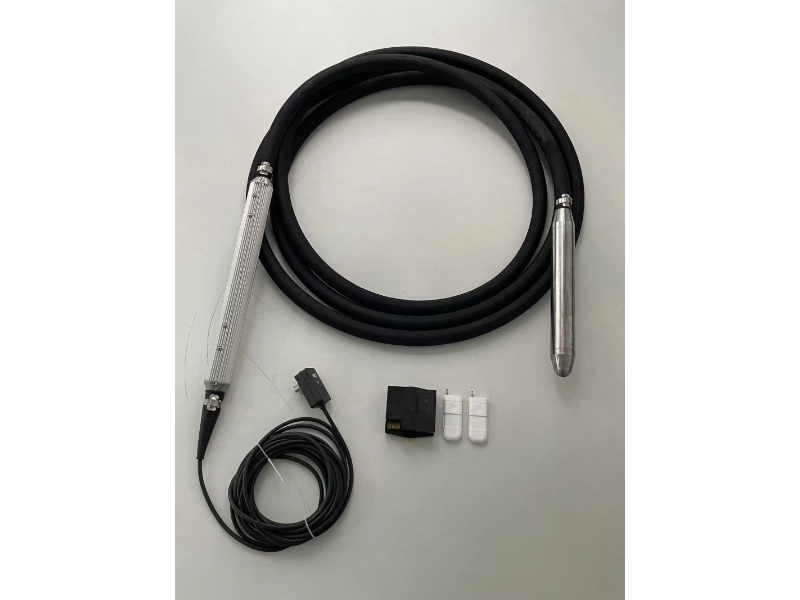
ONNEW is a leading concrete vibrator manufacturer in China. Our independently developed intelligent variable frequency concrete vibrator is a variable frequency vibrator with a built-in motor, eliminating the bulky external motor and fragile, inefficient, and jamming flexible shaft of traditional vibrators.

Civilian voltage 220V(customizable based on region).
Customized rubber tube, wear-resistant and tough, 1800 N pulling force, length 1-50m.
Built-in Permanent Magnet Synchronous Inverter Motor.
Streamlined configuration eliminates rebar obstruction.
Wear-resistant head, made of stainless steel.
Strong load capacity, wide voltage, high power, long life frequency conversion controller.
FAQ
1. How do I know if I am over-vibrating the concrete, and does it reduce strength?
Yes, over-vibration can severely compromise concrete strength. When concrete is vibrated for too long in one spot, segregation occurs. The heavy coarse aggregates sink to the bottom, while the lighter water and fine cement paste (laitance) are forced to the top. This results in a weak, powdery surface that is prone to cracking and dusting. You know it is time to slowly withdraw the vibrator when the concrete surface becomes shiny and level, the coarse aggregate blends into the surface, and large air bubbles stop breaking through the top.
2. Does the size of the vibrator head affect the compaction strength?
Absolutely. The diameter of the vibrator head directly correlates to its amplitude, centrifugal force, and radius of action. A larger head displaces more concrete and provides a stronger compaction effect over a wider area. However, the rule of thumb is to use the largest vibrator head that can comfortably fit between the steel reinforcement bars without getting stuck. If the head is too large, it may damage the rebar cage or formwork; if it is too small, it will take too long to compact the area, risking cold joints.
3. Can I use a high-frequency internal vibrator on very thin concrete slabs?
While internal vibrators are incredibly powerful, they are generally not recommended for thin slabs (less than 6 inches thick). If an internal poker is laid horizontally in a thin slab, it will bounce off the subgrade, potentially damaging the subbase and causing severe segregation in the concrete. For thin slabs, surface vibrators like vibrating screeds provide the appropriate top-down compaction effect without disturbing the aggregate distribution.