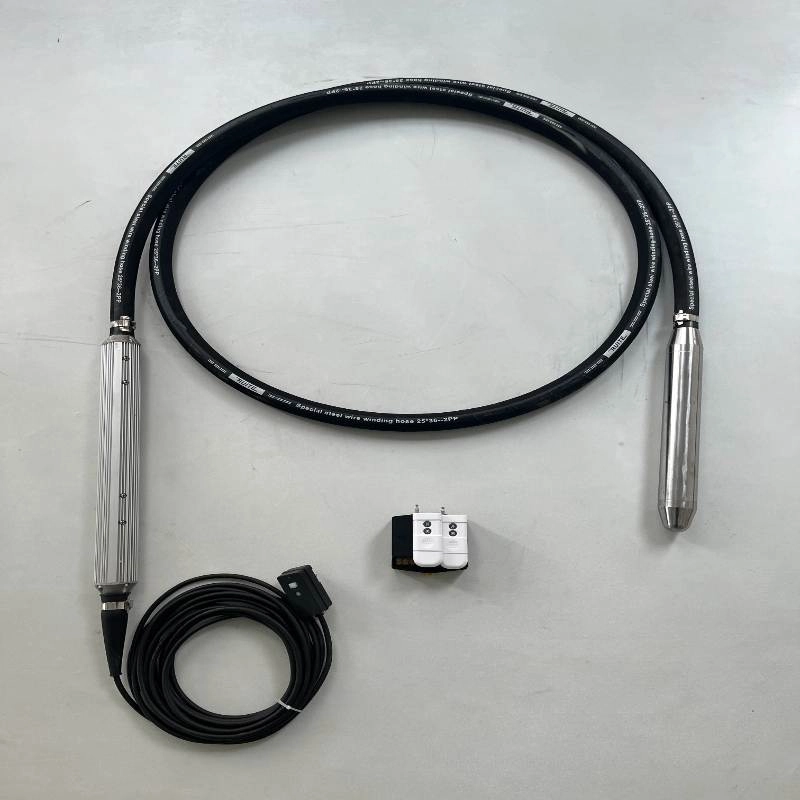
How Does High-Torque Design Improve Concrete Vibration Efficiency and Concrete Density?
Release time: 2026-10-31
Concrete compaction is a critical process in construction, directly affecting the strength, durability, and surface quality of concrete structures. During vibration, trapped air must be removed, and concrete particles need to rearrange to achieve a more uniform structure. High-torque design plays an important role in maintaining effective vibration performance, especially when working with dense concrete mixtures and demanding construction conditions.
How Does Torque Affect Concrete Vibration Performance?
Torque refers to the rotational force generated by a motor or drive system. In concrete vibration equipment, sufficient torque helps the vibration mechanism maintain stable operation when resistance increases.
When a vibrator operates inside concrete, the surrounding material creates resistance against the vibrating head. If the drive system cannot provide sufficient torque, vibration performance may become unstable under demanding conditions.
A properly designed high-torque system helps maintain consistent mechanical operation, allowing the vibrator to work more reliably in dense concrete and challenging applications.
How Does High-Torque Design Improve Concrete Compaction Efficiency?
One major benefit of high-torque design is its ability to support stable vibration under load.
During concrete placement, aggregates, cement paste, and reinforcement bars create different levels of resistance. Higher resistance can affect the operating performance of vibration equipment.
A suitable high-torque configuration helps the vibrator maintain its working performance, supporting the movement of concrete particles and allowing trapped air to escape more effectively.
This is particularly valuable in:
- Dense reinforced concrete structures.
- Low-slump and relatively stiff concrete mixtures.
- Large concrete foundations and structural components.
- Precast concrete production environments.
However, actual compaction efficiency also depends on vibration frequency, amplitude, head diameter, insertion spacing, and operating technique.
How Does Stable Vibration Improve Concrete Density?
Concrete density is closely related to the removal of entrapped air during compaction.
Insufficient vibration may leave air voids and honeycombing inside concrete structures, potentially reducing compressive strength, bonding quality, and long-term durability.
High-torque design can help maintain stable vibration performance under demanding working conditions. When combined with appropriate frequency and amplitude, it supports effective aggregate rearrangement and air release.
The main benefits include:
- Reduced Air Voids: Helps remove trapped air and minimize internal gaps.
- Improved Structural Uniformity: Supports more consistent concrete compaction throughout the pouring area.
- Better Reinforcement Coverage: Helps concrete flow around reinforcement bars when suitable vibrator dimensions and insertion methods are used.
- Improved Surface Quality: Reduces the risk of visible surface defects caused by insufficient compaction.
It is important to understand that torque alone does not determine concrete density. Proper vibration duration and placement are equally important.
How Does High-Torque Design Improve Construction Efficiency?
Construction productivity depends on how consistently equipment performs throughout the working process.
When vibration equipment experiences excessive resistance, unstable operation may interrupt concrete compaction and increase operating time.
A properly matched high-torque concrete vibrator can help maintain more consistent operation, reducing performance interruptions under demanding working conditions.
For contractors and precast concrete manufacturers, this can support:
- More consistent compaction across concrete sections.
- Reduced risk of repeated vibration caused by insufficient compaction.
- Improved workflow during continuous concrete placement.
- More reliable equipment operation in demanding applications.
Nevertheless, excessive vibration should be avoided because it may cause aggregate segregation and uneven concrete distribution.
What Should Buyers Consider When Selecting a High-Torque Concrete Vibrator?
For international buyers, selecting the right high-torque concrete vibrator requires evaluating several technical specifications:
| Selection Factor | What Buyers Should Check |
|---|---|
| Motor Power and Torque | Rated output and torque characteristics under load |
| Vibration Frequency | Suitability for the concrete mixture and application |
| Vibration Amplitude | Ability to provide effective compaction |
| Vibrator Head Diameter | Compatibility with reinforcement spacing |
| Operating Voltage | Compatibility with the available power supply |
| Continuous Operation | Thermal performance and operating stability |
| Equipment Configuration | Compatibility between motor, shaft, vibrator head, and inverter |
Choosing equipment based on actual construction conditions helps improve compaction quality while avoiding unnecessary equipment costs.
Choose ONNEW for Reliable Concrete Vibration Solutions
High-torque design contributes to more stable vibration performance, improved compaction efficiency, and consistent concrete quality under demanding construction conditions. However, achieving the best results requires matching motor torque, vibration frequency, amplitude, and equipment configuration to the specific concrete application.
ONNEW provides professional concrete vibration equipment solutions for construction contractors, precast concrete manufacturers, and industrial equipment distributors. Whether you need equipment for reinforced concrete structures, large-scale construction projects, or precast production, ONNEW can help you evaluate suitable vibration configurations.
Looking for a reliable high-torque concrete vibrator supplier? Contact ONNEW to discuss your project requirements, explore suitable equipment specifications, and find the right concrete vibration solution for your business.