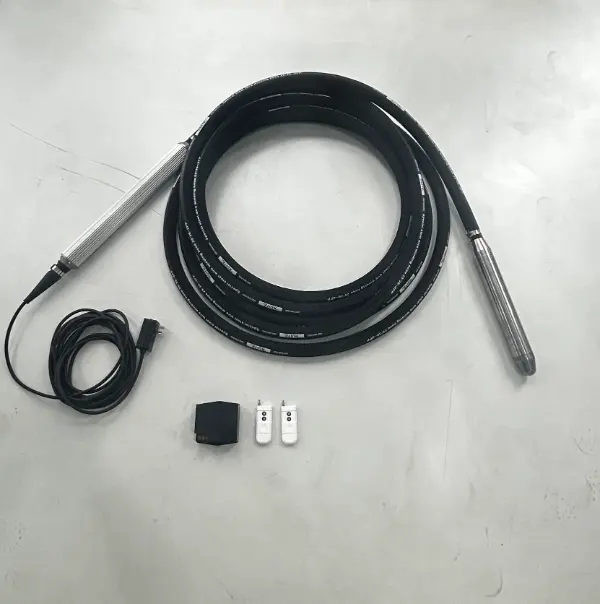
Reducing Maintenance Costs with Motor-in-head Vibrator Technology
Release time: 2026-07-11
Table of Contents
Introduction
When selecting concrete vibration equipment, contractors usually consider more than just the initial purchase cost. Long-term operating expenses, maintenance frequency, and equipment reliability also play an important role in determining the overall value of a machine.
Concrete vibrators are often used in demanding construction environments where continuous operation, dust, moisture, and frequent transportation can affect equipment performance. If equipment requires frequent repairs or component replacement, it may increase project costs and interrupt construction schedules.
With the development of concrete vibration technology, the Motor-in-head Vibrator has become an advanced solution that focuses on improving equipment structure and reducing maintenance challenges. ONNEW applies Motor-in-head technology in its concrete vibration solutions to provide a compact equipment design and help contractors achieve more reliable performance during long-term operation. By integrating the motor directly into the vibration head, this technology provides a more compact design and a different approach to long-term equipment management.

Why Maintenance Costs Matter for Concrete Vibration Equipment
For construction companies, equipment maintenance is closely related to project efficiency. A concrete vibrator may be used repeatedly during concrete pouring and consolidation, meaning that its stability directly affects daily construction operations.
In long-term projects, maintenance costs do not only include replacement parts and repair expenses. They may also involve equipment downtime, additional labor, and delays caused by unexpected failures.
As a result, contractors are increasingly paying attention to equipment that can provide reliable performance while reducing unnecessary maintenance requirements. A well-designed vibration system can help improve equipment utilization and create better long-term value for construction projects.
Common Maintenance Challenges of Traditional Concrete Vibrators
Traditional concrete vibrators have been widely used in the construction industry for many years. Many conventional systems rely on an external motor connected to the vibration head through a flexible shaft.
This structure can provide effective vibration performance, but the separated design also creates additional mechanical connections. During continuous operation, the flexible shaft and related transmission components may experience repeated movement and wear, requiring regular inspection and maintenance.
For projects that involve frequent concrete pouring or long working hours, these maintenance requirements may increase equipment management pressure. Contractors need to spend more time checking components, replacing worn parts, and ensuring that equipment remains available when needed.
The following comparison shows the main structural differences between traditional systems and Motor-in-head technology:
| Aspect | Traditional Concrete Vibrator | Motor-in-head Vibrator |
| Motor position | Motor is separated from the vibration head | Motor is integrated into the vibration head |
| Power transmission | Requires a flexible shaft and additional transmission components | Uses a more direct vibration transmission structure |
| Equipment structure | Contains more mechanical connection parts | Designed with a more compact integrated structure |
| Maintenance considerations | More components may require regular inspection | Simplified structure helps reduce maintenance pressure |
How Motor-in-head Vibrator Technology Reduces Maintenance Pressure
The main innovation of a Motor-in-head Vibrator is the integration of the motor inside the vibration head. Instead of transferring power through a separate flexible shaft, the vibration source is placed closer to the working area.
This design reduces dependence on traditional transmission components and creates a shorter vibration transmission path. With fewer mechanical connections involved, the equipment structure becomes simpler, which can help reduce potential wear points during long-term operation.
For operators, a more integrated structure also makes daily equipment management easier. Inspection procedures can become more straightforward, while the compact design improves handling convenience on different construction sites.
The Relationship Between Equipment Design and Long-Term Reliability
The structure of construction equipment has a direct impact on its durability and maintenance requirements. When machines contain multiple moving transmission components, each part may become a potential maintenance point during extended use.
A Motor-in-head Vibrator simplifies the traditional structure by combining key components into one integrated system. This design approach helps reduce unnecessary mechanical complexity while maintaining stable vibration performance.
For contractors, the value of this technology is not only reflected in equipment operation but also in the entire service cycle. Easier maintenance, reduced downtime, and more consistent performance can help companies better manage construction costs.
Why Contractors Consider Long-Term Equipment Value
When purchasing Construction Equipment, professional users usually evaluate the total cost of ownership rather than focusing only on the initial investment.
The long-term value of equipment is influenced by several factors:
| Consideration | Impact on Construction Operations |
| Maintenance frequency | Affects labor costs and equipment availability |
| Component durability | Influences replacement requirements and service life |
| Operation convenience | Determines working efficiency on job sites |
| Equipment reliability | Helps reduce unexpected downtime |
A vibration system that performs consistently and requires less maintenance can provide greater value throughout the project lifecycle. This is why more contractors are exploring advanced solutions such as Motor-in-head technology.
Applications Where Equipment Reliability Matters
Different construction environments have different expectations for concrete vibration equipment.
In building construction, workers often need to move equipment between different areas during concrete pouring. A compact and easy-to-manage vibration system can improve working convenience and support more efficient construction processes.
In precast concrete manufacturing, equipment reliability is especially important because production depends on consistent operation. Stable vibration performance helps manufacturers maintain product quality while reducing interruptions caused by equipment problems.
For infrastructure projects such as bridges, tunnels, and large structural works, construction equipment must often operate under demanding conditions for extended periods. In these applications, reducing maintenance requirements can help improve project continuity and overall efficiency.
ONNEW’s Motor-in-head Vibrator Solutions
ONNEW focuses on developing intelligent concrete vibration equipment based on the needs of modern construction applications. By applying Motor-in-head technology, ONNEW provides a more integrated vibration solution designed to simplify equipment structure and support reliable concrete consolidation.
Compared with traditional vibration systems, ONNEW’s approach reduces dependence on conventional transmission components and provides a more compact solution for contractors seeking efficient Concrete Vibration Equipment.
Through continuous improvement of vibration technology and equipment design, ONNEW helps construction companies achieve more stable operation and better long-term equipment value.
FAQ
Why is maintenance important for concrete vibrators?
Maintenance directly affects equipment reliability, operating costs, and construction efficiency. Reducing unnecessary maintenance can help contractors improve equipment utilization and avoid unexpected downtime.
How does Motor-in-head Vibrator reduce maintenance requirements?
A Motor-in-head Vibrator integrates the motor into the vibration head, reducing the need for some traditional transmission components and simplifying the overall equipment structure.
What should contractors consider when choosing concrete vibration equipment?
Contractors should consider vibration performance, equipment reliability, working conditions, maintenance requirements, and long-term operating costs.
Is Motor-in-head Vibrator suitable for large construction projects?
Yes. Motor-in-head Vibrators can be used in various applications, including building construction, precast concrete production, and infrastructure projects where stable concrete consolidation is required.