How Does Concrete Vibration Remove Air Bubbles?
Release time: 2026-11-06
Concrete vibration is an essential step in achieving dense, uniform, and high-quality concrete structures. During mixing, transportation, and pouring, air can become trapped inside fresh concrete, potentially causing honeycombing, surface voids, and internal cavities after hardening. Concrete vibration uses mechanical energy to temporarily improve the mobility of fresh concrete, allowing trapped air to rise to the surface and escape while helping the concrete fill gaps around aggregates and reinforcement. Understanding how vibration works, selecting the right equipment, and controlling vibration time are key to improving concrete compaction and construction quality.
Table of Contents
1. Why Do Air Bubbles Form in Concrete?
Concrete consists of cement, sand, aggregates, water, and chemical admixtures. During mixing, transportation, pumping, and pouring, air can become trapped within the fresh concrete, creating bubbles and voids of different sizes.
Common causes include:
- Air entrainment during mixing: Air may become trapped within the cement paste as cement and aggregates are mixed.
- Uneven concrete placement: When concrete falls from excessive heights or encounters obstacles during placement, air can accumulate in certain areas.
- Obstructions from reinforcement and formwork: In densely reinforced structures, concrete may have difficulty flowing into narrow spaces, increasing the risk of trapped air and voids.
- Poor concrete workability: Low slump or an unsuitable mix design can make it more difficult for trapped air to escape.
It is important to understand that not all air bubbles in concrete are defects. Some concrete mixtures intentionally contain uniformly distributed microscopic air voids to improve freeze-thaw resistance. Therefore, the purpose of vibration is to remove unwanted entrapped air, not to eliminate all air from the concrete.
2. How Does Concrete Vibration Remove Air Bubbles?
The working principle of concrete vibration involves using mechanical energy to change the movement of particles within fresh concrete, allowing trapped air to escape more easily.
Step 1: Reducing Friction Between Concrete Particles
A concrete vibrator generates repeated mechanical vibrations, changing the contact conditions between cement paste and aggregate particles. This temporarily reduces internal friction and improves the mobility of fresh concrete, allowing it to flow more easily around reinforcement and into formwork.
Step 2: Encouraging Air Bubbles to Move
Under vibration, trapped air bubbles begin to move through the concrete mixture. Smaller bubbles may combine into larger ones, making it easier for them to rise toward the concrete surface through paths of lower resistance.
Step 3: Releasing Air from the Concrete Surface
As the bubbles continue moving upward, they eventually reach the surface and escape into the surrounding air. At the same time, fresh concrete fills previously unoccupied spaces, helping create a more uniform and compact internal structure.
Step 4: Achieving Uniform Concrete Compaction
When adequate vibration has been applied, the concrete surface generally becomes more uniform, and the release of larger air bubbles gradually decreases. Vibration should then be stopped to avoid excessive movement that could cause aggregate settlement or segregation.
3. What Are the Common Methods of Concrete Vibration?
Different construction structures and placement conditions require different vibration methods.
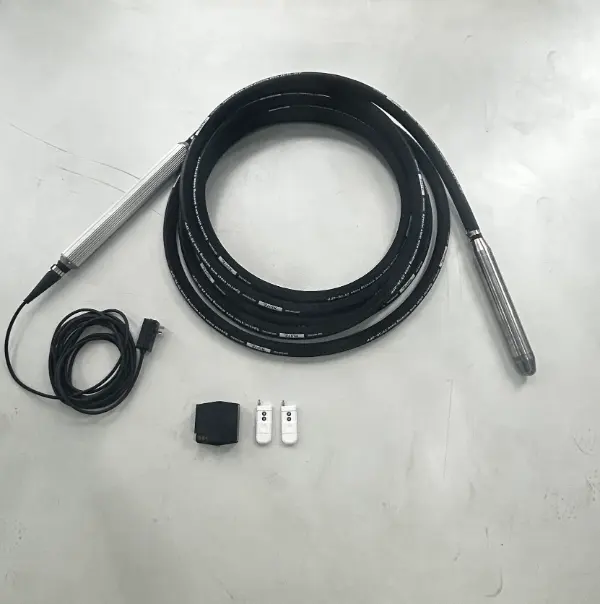
1. Internal Vibration: An internal concrete vibrator, commonly called a concrete poker vibrator, is inserted directly into fresh concrete to remove trapped air through mechanical vibration. It is widely used for foundations, columns, beams, walls, and other conventional concrete structures.
2. External Vibration: External vibrators are attached to the outside of formwork, transmitting vibration through the formwork into the concrete. This method is suitable for densely reinforced structures, complex forms, or areas where direct vibrator insertion is difficult.
3. Surface Vibration: Surface vibrators, such as vibrating screeds and plate vibrators, compact concrete from the top. They are commonly used for floor slabs, concrete pavements, and relatively thin concrete sections.
4. High-Frequency Vibration: High-frequency concrete vibrators generate rapid mechanical oscillations that help improve particle movement and promote air release. They are suitable for applications requiring efficient compaction, consistent vibration performance, and high-quality concrete finishes.
4. How Can Proper Vibrator Operation Reduce Air Bubbles?
Good compaction depends not only on the vibrator itself but also on proper operating techniques and parameter control.
- Maintain appropriate insertion spacing: During internal vibration, adjacent vibration zones should overlap sufficiently to prevent poorly compacted areas.
- Control insertion depth: When placing concrete in multiple layers, the vibrator should penetrate slightly into the previous layer to improve bonding between layers.
- Control vibration time: Insufficient vibration may leave trapped air, while excessive vibration can cause segregation. The appropriate duration depends on the concrete mix, equipment performance, and site conditions.
- Insert and withdraw the vibrator steadily: The vibrator should be inserted and withdrawn smoothly to reduce the risk of leaving holes in the concrete.
- Select equipment according to construction conditions: Reinforcement density, structural thickness, concrete workability, and aggregate size should all be considered when selecting vibration frequency, amplitude, and motor power.
5. How to Choose the Right Concrete Vibrator?
For construction contractors, precast concrete manufacturers, and construction equipment buyers, selecting the right concrete vibrator requires evaluating several technical factors.
- Vibration Frequency: Frequency affects particle movement and vibration transmission. It should be selected according to concrete properties and construction requirements.
- Vibration Amplitude and Centrifugal Force: These parameters should match aggregate size, concrete consistency, and structural dimensions.
- Motor Power: The motor should provide sufficient power to support continuous operation under actual working loads.
- Equipment Design: Motor-in-head high-frequency vibrators and external vibration equipment serve different construction requirements and installation conditions.
- Operating Reliability: Motor cooling, sealing performance, electrical safety, and ease of maintenance all influence equipment service life and long-term operating costs.
6. How Does ONNEW Help Solve Air Bubble Problems in Concrete Vibration?
Air bubbles, uneven compaction, and inconsistent concrete quality are common challenges in construction and precast concrete production. Choosing the right vibration equipment is essential for improving concrete density and reducing surface and internal defects.
ONNEW provides high-frequency concrete vibrators and related vibration solutions designed to support effective concrete compaction across different construction applications. By combining high-frequency vibration technology with proprietary inverter technology, ONNEW helps deliver stable vibration output according to the specific equipment configuration. This supports improved fresh concrete mobility, promotes the release of entrapped air, and helps achieve more uniform concrete compaction.
ONNEW can provide equipment selection support for different applications:
- Building Construction: For foundations, beams, columns, and walls, suitable internal vibration equipment helps improve concrete compaction and reduce the risk of honeycombing and voids.
- Precast Concrete Production: Vibration equipment can be selected according to mold dimensions, reinforcement arrangements, and concrete mix characteristics to improve consistency in precast components.
- Bridge Construction and Large-Scale Projects: Vibration solutions can be matched to structural requirements, concrete workability, and the required compaction coverage.
- Customized Equipment and Technical Support: ONNEW can provide product configuration recommendations based on customers’ power supply conditions, working environments, and equipment requirements.
For construction contractors and precast concrete manufacturers looking to improve concrete density, reduce air-related defects, and achieve more consistent construction quality, choosing the right vibration equipment is essential.
With its high-frequency concrete vibration technology, proprietary inverter technology, and continuous R&D capabilities, ONNEW provides reliable concrete vibration equipment solutions for a wide range of construction applications. Contact ONNEW today to discuss your project requirements and find the right high-frequency concrete vibrator for your application.