Which High-Frequency Concrete Vibrator Is Best for My Application?
Release time: 2026-09-07
There is no single answer when it comes to selecting the right high-frequency concrete vibrator for various construction projects. Elements such as walls, columns and beams, foundations, slabs, and precast components differ in terms of concrete slump, reinforcement density, structural thickness, and available workspace; therefore, equipment selection must be based on actual site conditions. As a professional manufacturer of high-frequency concrete vibration equipment, ONNEW offers tailored equipment configurations for different application scenarios, helping contractors and overseas buyers make accurate product selections.
Table of Contents
What should be considered first when choosing a high-frequency concrete vibrator?
Before selecting a specific model, it is advisable to clarify the following points:
What type of concrete are you using?
What is the concrete slump?
How dense is the reinforcement?
What is the thickness of the concrete structure?
How deep does the vibrator need to reach?
Is the working space narrow or open?
What power supply is available on the job site?
These factors directly influence the vibrator’s size and configuration. For instance, columns with dense reinforcement usually require a smaller-diameter vibrator head, whereas large-area foundations prioritize the effective vibration range and construction efficiency.
Which vibrator should be chosen for different application scenarios?
A preliminary assessment can be made based on typical application scenarios:
| Application | Recommended Vibrator Characteristics | Key Considerations |
|---|---|---|
| Reinforced Concrete Columns | Small or medium vibrator head | High reinforcement density and limited working space |
| Concrete Walls | Flexible vibrator with a suitable hose length | Wall thickness and working depth |
| Concrete Beams | Compact vibrator head | Reinforcement density and available working space |
| Concrete Foundations | Larger vibrator head and wider radius of action | Concrete volume and consolidation efficiency |
| Concrete Slabs | Suitable coverage and flexible operation | Working area and insertion spacing |
| Precast Concrete Components | Compact and controllable vibrator | Mold size, component shape, and surface quality |
| Mass Concrete Structures | Higher vibration force and appropriate vibrator head size | Concrete thickness and construction efficiency |
This table helps buyers with the initial screening process, though the final model selection should be confirmed based on specific concrete conditions.
How should the vibrator head diameter be selected?
The vibrator head diameter is a crucial parameter when selecting a high-frequency concrete vibrator.
Smaller-diameter vibrator heads can usually penetrate areas with dense reinforcement and narrow spaces more easily, making them suitable for walls, columns, beams, and complex precast components. Larger-diameter vibrator heads offer a wider effective range; provided there is sufficient workspace, they are better suited for foundations, mass concrete, and large-scale structures.
It is important to note that a larger vibrator head does not necessarily mean the equipment is the best fit for the project. If the vibrator head cannot easily fit between reinforcing bars, or if the workspace is restricted, oversized equipment can actually reduce operational efficiency.
How should frequency and amplitude be matched?
Frequency and amplitude work together to determine the effectiveness of concrete consolidation.
High-frequency vibrators rapidly transmit vibrations to fresh concrete, expelling air and helping to densify the mix. However, when selecting equipment, one should not focus solely on the frequency value; factors such as amplitude, centrifugal force, and concrete workability must also be considered.
For concrete with good flowability, prioritize stable high-frequency vibration and appropriate amplitude; for concrete with low slump or thick structural sections, focus more on the equipment’s vibration force and effective radius of action.
Therefore, when comparing models, it is recommended to consider the following parameters simultaneously:
Vibration Frequency + Amplitude + Centrifugal Force + Head Diameter + Radius of Action
…rather than selecting equipment based solely on “maximum frequency.”
Why are hose length and power configuration also important?
Beyond core vibration parameters, hose length and power configuration directly impact ease of operation.
If the equipment is used for deep foundations, thick walls, or large formwork structures, the hose length should be selected based on the construction depth. A hose that is too short may limit the operating range, while one that is too long can increase the physical burden on the operator.
For overseas projects, it is essential to verify the on-site voltage and frequency to ensure the vibrator’s power configuration matches local conditions. To meet the specific procurement needs of different countries and projects, it is advisable to confirm exact electrical specifications with the manufacturer before placing an order.
How can I quickly determine which vibrator is right for my project?
You can use a simple selection logic:
Project Type → Concrete Slump → Rebar Density → Structural Thickness → Construction Depth → Workspace → Vibrator Head Diameter → Frequency & Amplitude → Hose Length → Power Configuration.
For example:
Columns with dense rebar
→ Prioritize vibrator heads with small diameters and high maneuverability.
Large-area foundations
→ Prioritize larger vibrator heads with a wider radius of action. Narrow Precast Elements
→ Focus on vibrator head size, equipment maneuverability, and hose configuration.
Deep Concrete Structures
→ Focus on hose length and the equipment’s continuous operating capability.
Why Consider ONNEW High-Frequency Concrete Vibrators?
For overseas buyers seeking high-frequency poker vibrator, ONNEW offers product configurations tailored to specific construction applications.
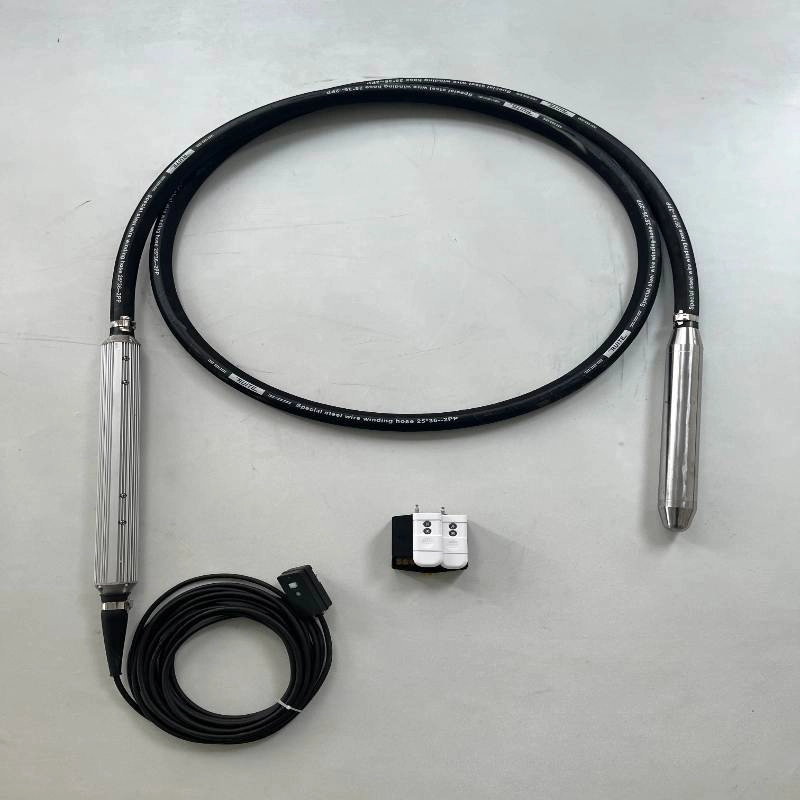
ONNEW specializes in high-frequency concrete vibration technology and equipment manufacturing. Its product lineup includes smart variable-frequency high-frequency concrete vibrators featuring a “Motor-in-Head” design, where the motor is integrated directly into the vibrator head. Buyers can select the appropriate configuration based on factors such as construction depth, structural type, on-site power supply, and operational requirements.
If you are unsure about the specific model, it is recommended to provide details regarding the concrete type, slump, structural dimensions, rebar density, construction depth, and on-site power conditions when consulting ONNEW. The manufacturer can use this information to determine the optimal vibrator head size, hose length, and product configuration, thereby minimizing the risks associated with selecting a model based on a single parameter.
The ideal high-frequency vibrating poker should match your specific construction conditions rather than simply being the model with the highest power or frequency. Factors ranging from concrete type, slump, and rebar density to vibrator head diameter, effective radius, hose length, and on-site power supply all influence actual performance. ONNEW specializes in the R&D and manufacturing of high-frequency concrete vibration equipment; the company provides product selection guidance and technical support tailored to project needs, helping customers find vibration solutions that best suit their actual application requirements.