
High Frequency vs Low Frequency Concrete Vibrator: Which is Better
Release time: 2026-07-03
Table of Contents
In the complex and demanding world of construction, the structural integrity and aesthetic finish of a concrete pour dictate the success of an entire project. When wet concrete is poured, it naturally entraps thousands of tiny air bubbles and creates empty voids, commonly referred to as honeycombing. If these pockets are not eliminated before the mixture cures, the final structure will suffer from severely compromised compressive strength, increased permeability, and surface blemishes. The solution to this universal construction challenge is proper consolidation through vibration.
However, one of the most debated topics among structural engineers, site managers, and contractors is the choice of equipment. Specifically, the debate often centers around one critical question: when comparing different consolidation tools, which technology reigns supreme? To answer this, we must dive deep into the mechanics of concrete consolidation, explore the differences in vibrations per minute (VPM), and ultimately determine the winner in the battle of high frequency versus low frequency models.

The Science of Concrete Consolidation: Amplitude and Frequency
Before analyzing specific equipment types, it is essential to understand the physics of how vibration affects a wet concrete mix. Consolidation is governed by two primary forces:
- Amplitude: This refers to the maximum distance the vibrating head moves from its resting position. High amplitude creates a larger radius of influence, aggressively pushing large aggregate particles into place.
- Frequency: Measured in Vibrations Per Minute (VPM), this dictates how fast the vibrator head oscillates. High frequencies are uniquely capable of breaking the surface tension of the cement paste, turning the stiff mixture into a temporary liquid state (liquefaction) and allowing trapped air to rise to the surface.
The interaction between the mix design (aggregate size, slump, and water-to-cement ratio) and these two physical forces determines which type of equipment will yield the best results.
The Traditional Workhorse: Understanding the Low-Speed Option
Historically, traditional construction sites have relied on equipment that operates at a lower VPM. A low frequency concrete vibrator typically operates within the range of 3,000 to 9,000 VPM. What these machines lack in rapid oscillation speed, they make up for with significant amplitude.
How It Works
These machines utilize larger eccentric weights driven by standard electric, pneumatic, or gas-powered motors. The powerful, sweeping motions generated by the high amplitude effectively agitate the larger, heavier aggregates (like crushed stone and coarse gravel) within the mix.
Ideal Applications
Low-speed models are generally best suited for mass concrete pours with a high slump (a wetter, more fluid mix). They are frequently utilized in:
- Large-scale foundational footings.
- Heavy civil engineering projects such as dams and thick retaining walls.
- Projects utilizing mixtures with particularly large and heavy aggregate materials.
Pros and Cons
Advantages:
- Deep Penetration: The high amplitude provides a massive radius of action, meaning the operator needs to insert the poker fewer times over a large area.
- Durability: Operating at lower speeds generates less internal heat and friction, often resulting in less wear and tear on the internal bearings and the flexible shaft.
- Cost-Effective: Traditional low-speed models are generally less expensive to purchase and maintain.
Disadvantages:
- Poor Air Removal: They struggle to effectively liquefy the fine cement paste, meaning micro-bubbles often remain trapped, which can lead to surface pitting.
- Risk of Segregation: If held in one place for too long, the aggressive shaking can cause the heavy aggregates to sink to the bottom while the watery paste rises to the top, ruining the structural integrity of the pour.
The Modern Standard: The High-Speed Alternative
As architectural designs have evolved to require smoother finishes, and as structural engineering has demanded lower-slump, higher-strength concrete mixtures, the industry has shifted toward faster consolidation methods. A standard high frequency concrete vibrator operates at an impressive speed of 12,000 to 18,000 VPM.
How It Works
By utilizing a much faster rotation, these tools create a microscopic, rapid vibration that specifically targets the mortar and cement paste rather than the large rocks. This rapid oscillation drastically reduces the internal friction between the solid particles in the mix. The concrete rapidly liquefies, allowing gravity to pull the aggregates into a dense, tightly packed formation while forcing the lighter air bubbles to escape to the surface.
Ideal Applications
High-speed pokers are considered the absolute gold standard for:
- Low-slump (stiff) concrete mixes.
- Architectural concrete where a flawless, visually appealing surface finish is mandatory.
- Precast concrete manufacturing.
- Heavily congested formwork with dense steel rebar grids, where concrete needs to flow smoothly around obstacles.
Pros and Cons
Advantages:
- Superior Surface Finish: Almost entirely eliminates surface bug holes and honeycombing.
- Higher Structural Density: Achieves maximum compaction, leading to higher final compressive strength and lower permeability to water and chemicals.
- Better Flow: Excellent for pushing stiff concrete through complex, rebar-heavy structural columns and beams.
Disadvantages:
- Shorter Radius of Action: The lower amplitude means the operator must insert the poker at closer intervals to ensure overlapping zones of influence.
- Higher Maintenance: The extreme RPMs generate significant heat. If the poker is operated outside of the wet concrete (which acts as a crucial coolant), the internal bearings can overheat and fail rapidly.
The Pinnacle of Consolidation Tech: Smart Vibrators
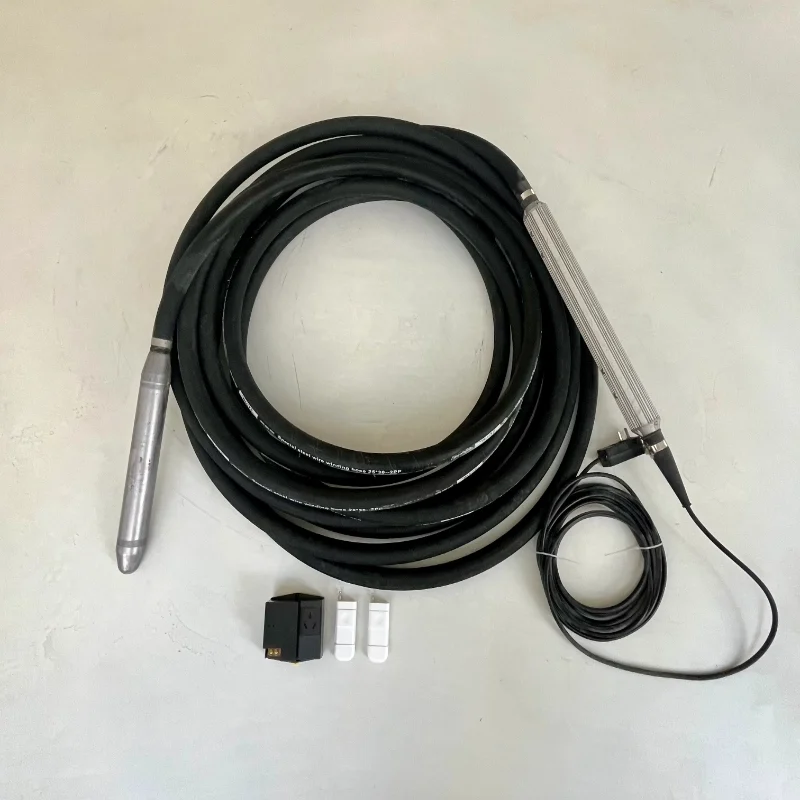
In recent years, the construction equipment market has witnessed a technological revolution. We have now entered the era of the intelligent high frequency concrete vibrator. These cutting-edge tools bridge the gap between raw mechanical power and microchip-controlled precision.
Unlike traditional setups that rely on a separate drive unit and a long, heavy flexible shaft, these advanced units feature a permanent magnet synchronous motor built directly into the poker head itself. Furthermore, they are equipped with integrated electronic micro-inverters.
Why is it “Intelligent”?
The smart systems continuously monitor the resistance and load presented by the wet concrete. If the mix is particularly stiff, the onboard electronics automatically adjust the power draw to maintain a consistent 12,000+ VPM without stalling. Conversely, if the machine is pulled out of the mix, smart sensors detect the lack of resistance and can instantly reduce the RPMs or shut the unit down, preventing catastrophic overheating and bearing failure. They also offer multi-speed settings, allowing operators to fine-tune the frequency based exactly on the specific mix design delivered by the batch plant that day.
Comparison Table
To summarize the technical differences and help you make an informed decision for your procurement or project needs, refer to the detailed comparison table below:
| Feature/Metric | Low-Speed / Standard Vibrators | High-Speed Internal Vibrators | Intelligent / Smart Vibrators |
|---|---|---|---|
| Operating Speed (VPM) | 3,000 – 9,000 VPM | 12,000 – 18,000 VPM | 12,000 – 18,000 VPM (Auto-adjusting) |
| Amplitude | High (Aggressive aggregate movement) | Low (Focuses on paste liquefaction) | Low to Medium (Electronically optimized) |
| Radius of Influence | Very Wide | Narrow to Moderate | Moderate |
| Best Suited Mix Type | High-slump, large aggregate | Low-slump, stiff mixes | All mixes (highly adaptable) |
| Surface Finish Quality | Average (Prone to some bug holes) | Excellent (Smooth, architectural finish) | Flawless (Consistent compaction) |
| Rebar Congestion | Poor performance in dense rebar | Highly effective | Highly effective |
| Overheating Risk | Low to Moderate | High (If run outside of concrete) | Near Zero (Built-in thermal protection) |
| Initial Investment Cost | Low ($) | Moderate ($$) | High ($$$) |
How to Choose the Right Equipment for Your Project
Determining “which is better” is not a matter of simply picking the most powerful tool; it is about matching the equipment to the exact specifications of the job site.
- Analyze the Mix Design: If you are pouring a massive, high-slump foundation with oversized aggregates, standard lower-RPM equipment will save you time and money. However, if you are working with a low-slump, high-strength commercial mix, high-speed units are absolutely non-negotiable for proper consolidation.
- Evaluate the Formwork and Rebar: In structural columns, shear walls, and heavily reinforced suspended slabs, standard models with high amplitude can actually damage the formwork or bounce off the rebar, causing further segregation. High-RPM models fluidize the mix gently, allowing it to encapsulate the steel seamlessly.
- Consider the Desired Finish: If the concrete will remain exposed (such as in modern architectural designs, lobbies, or polished concrete floors), you must eliminate surface voids. High-RPM and smart variants are the only choices that will deliver that glass-like, void-free finish.
- Factor in Long-Term ROI: While smart, built-in-motor units require a higher upfront capital investment, their auto-adjusting nature and thermal protection mechanisms drastically reduce equipment downtime, repair costs, and operator fatigue. For professional contractors pouring concrete daily, the return on investment is incredibly fast.
Conclusion
In the battle of frequencies, there is no one-size-fits-all answer, but there is a clear trajectory in modern construction. While lower-RPM models still hold value in specific heavy civil and mass-pour applications, high-speed oscillation is universally recognized as the superior method for achieving structural density, high compressive strength, and architectural-grade aesthetics. For forward-thinking contractors looking to eliminate human error, prevent equipment burnout, and guarantee a perfect pour every time, investing in technologically advanced, self-regulating equipment is undeniably the best path forward.
FAQs
1. Can using the wrong vibration frequency damage the concrete?
Yes, absolutely. Using a tool with excessive amplitude and low speed on a wet, high-slump mix can cause severe “segregation.” This is when the heavy aggregates sink to the bottom of the formwork, and the weaker cement paste and water rise to the top (laitance). This results in a weak surface that is prone to cracking, dusting, and structural failure. Over-vibrating is just as dangerous as under-vibrating.
2. How long should I leave the poker in the concrete during high-speed consolidation?
A general rule of thumb for high-speed consolidation is to insert the poker rapidly to the bottom of the lift, hold it there for roughly 5 to 15 seconds, and then withdraw it very slowly (about 1 to 2 inches per second). You will know the concrete is properly consolidated when a thin sheen of water appears on the surface, large air bubbles stop escaping, and the tone/pitch of the motor drops to a steady hum.
3. Are smart, self-regulating consolidation tools really worth the extra investment?
For continuous, professional use, yes. Traditional tools suffer from a high rate of mechanical failure because operators frequently leave them running while pulled out of the wet concrete, causing the bearings to melt from friction. Smart tools feature microprocessors that sense the lack of load and automatically reduce power, essentially eliminating overheating. Furthermore, because the motor is located inside the poker head rather than relying on a heavy flexible drive shaft, they transmit far less hand-arm vibration (HAV) to the operator, improving safety and reducing fatigue.
