Why a High-Frequency Concrete Vibrator is the Preferred Choice for Precast Components
Release time: 2026-04-13
Table of Contents
The global construction industry is undergoing a radical shift toward off-site manufacturing. Precast concrete production—the process of casting concrete in a reusable mold or “form,” curing it in a controlled environment, and then transporting it to the construction site—has become the backbone of modern infrastructure. From massive bridge girders and structural columns to intricate architectural facades, the quality of these components determines the safety and longevity of our built environment.
At the heart of high-quality precast manufacturing lies a critical process: consolidation. To achieve the high-strength specifications required for modern projects, the air entrapped during the pouring process must be removed. While traditional vibration methods served the industry for decades, the rise of specialized mixes and complex geometries has made the High Frequency Concrete Vibrator the gold standard. In this article, we analyze why high-frequency technology is the essential Concrete Vibrator for Precast Concrete Production and how it redefines Concrete Vibrator for Compaction Efficiency.
The Physics of Consolidation: High Frequency vs. Low Frequency
To understand why high-frequency tools are preferred, one must examine the physics of concrete behavior under stress. Concrete is a non-Newtonian fluid with a high yield stress. In a precast plant, the goal is to “liquefy” the mix momentarily so it can fill every corner of the mold.
The Role of Acceleration
In the realm of vibration, two variables matter: Amplitude (the distance of the movement) and Frequency (the speed of the movement). Conventional vibrators often rely on high amplitude and low frequency (around 3,000 to 6,000 VPM). While this moves a lot of material, it often lacks the “acceleration” needed to displace tiny air bubbles trapped near the mold surface or within dense reinforcement.
A High Frequency Concrete Vibrator, operating at 10,000 to 18,000 vibrations per minute (VPM), provides high centrifugal force with lower amplitude. This high acceleration creates a “harmonic wave” that specifically targets the friction between the aggregate particles. By reducing this internal friction, the concrete becomes significantly more fluid, allowing for a faster and more complete consolidation.
Achieving True Liquefaction
In precast production, time is a critical variable. The faster the concrete reaches a state of liquefaction, the sooner the production line can move. High-frequency technology achieves this state almost instantly upon insertion, making it the premier Concrete Vibrator for Compaction Efficiency.
Navigating Complex Molds and Dense Reinforcement
One of the primary advantages of precast components is the ability to create complex shapes and utilize heavy reinforcement (rebar) that would be difficult to cast in-place. However, these complex designs create “shadow zones” where air can become trapped.
Flowability in Intricate Geometries
Precast molds for architectural panels or bridge segments often feature sharp angles, thin sections, and narrow channels. A standard vibrator may struggle to push the viscous concrete into these areas without causing “segregation” (the separation of water, cement, and aggregate).
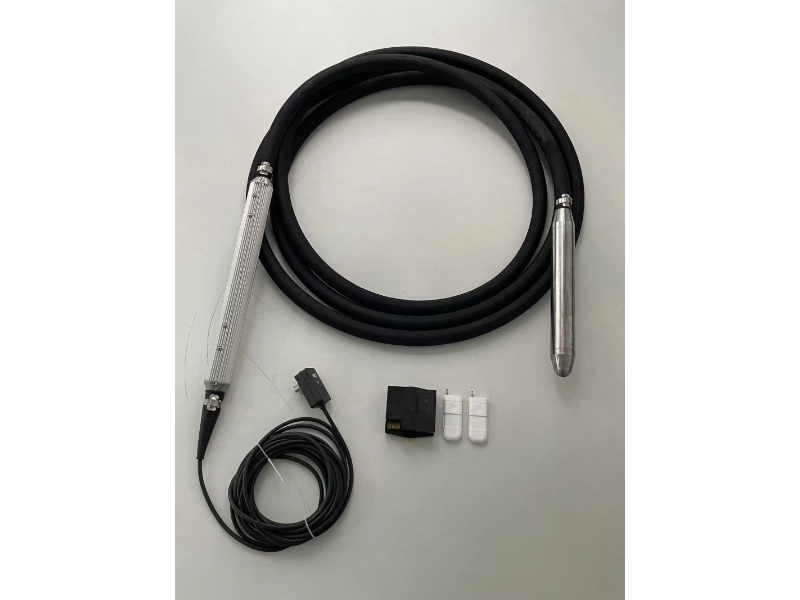
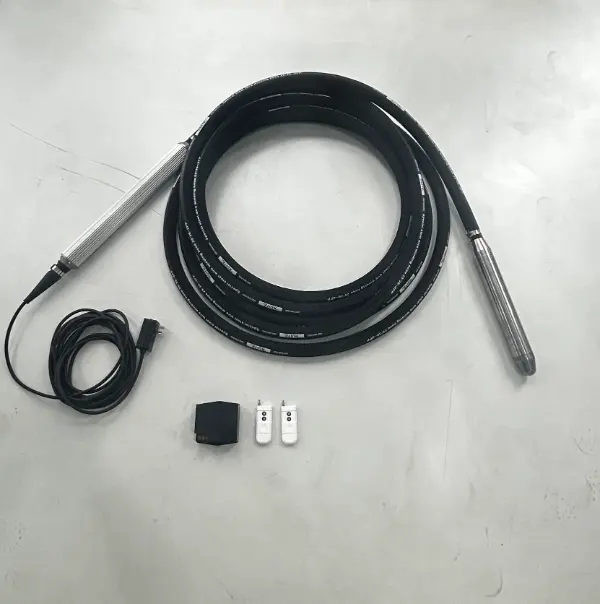
The high-frequency waves produced by tools like the Onnew Handheld High Frequency Vibrator are shorter and more intense. These waves propagate more effectively through the reinforcement steel, actually using the rebar as a secondary conductor for the vibration. This ensures that even the most remote corners of the mold are filled with a dense, uniform mix.
Preventing Rebar-to-Concrete Voids
In precast production, the bond between the steel and concrete is paramount. If air pockets remain around the rebar, the structural integrity is compromised, and the risk of internal corrosion increases. High-frequency vibration ensures a “skin-tight” bond between the cement paste and the steel, ensuring the component meets its design strength.
Optimizing Production Speed and Turnover Rates
In a precast plant, the “cycle time”—the time it takes to set the mold, pour the concrete, cure it, and strip the mold—directly dictates profitability.
Reduced Vibration Time
Because a High Frequency Concrete Vibrator works more efficiently at the molecular level, the actual time the vibrator needs to be in the concrete is reduced. In a typical precast production run, switching to high-frequency equipment can reduce consolidation time by up to 30-50%. This allows for faster pouring of the next batch and increases the daily output of the factory.
Minimizing Post-Production Repair
“Bugholes” (surface voids) and “honeycombing” are the enemies of precast quality. If a component comes out of the mold with surface defects, it requires expensive and time-consuming manual patching. In some cases, structural defects lead to the total rejection of the component. By using a specialized Concrete Vibrator for Precast Concrete Production, manufacturers can achieve a “cast-off-the-mold” finish that requires zero remedial work, saving thousands of dollars in labor and material costs.
Enhancing Aesthetic and Surface Finish Quality
For architectural precast, the surface finish is a primary performance requirement. High-frequency vibration is uniquely suited for achieving “glass-smooth” or “polished” concrete finishes.
Micro-Bubble Migration
The high-frequency vibrations create a “pumping” effect. Because the waves are so rapid, they create a pressure gradient that forces micro-bubbles to migrate toward the surface and escape. This is particularly important for self-consolidating concrete (SCC) or high-performance mixes used in precast, where the viscosity is high.
Color and Texture Consistency
Low-frequency vibration can sometimes cause “vibration lines” or inconsistent aggregate distribution, leading to blotchy colors or uneven textures on the finished precast panel. High-frequency tools provide a more uniform energy distribution throughout the mold, ensuring that the pigment and fine aggregates are evenly dispersed, resulting in a premium aesthetic result.
Ergonomics and Equipment Longevity: The Onnew Advantage
While the technical benefits to the concrete are clear, the impact on the operator and the equipment is equally important. Traditional mechanical vibrators with flexible shafts are heavy, cumbersome, and prone to “whip,” which causes operator fatigue.
The modern Onnew Handheld High Frequency Vibrator utilizes “motor-in-head” technology or advanced electronic converters. This design offers several advantages:
- Constant Speed Under Load: Unlike traditional units that slow down when pushed into thick concrete, electronic high-frequency vibrators maintain their VPM, ensuring consistent Compaction Efficiency.
- Low Hand-Arm Vibration (HAV): High-frequency tools are often designed to isolate the vibration to the head, reducing the physical toll on the worker.
- Durability: With fewer moving parts in the transmission (no long flexible shafts that kink or break), the maintenance costs for precast plants are significantly lowered.
Sustainable Precast: Reducing Waste and Carbon Footprint
The construction industry is under pressure to reduce its carbon footprint. High-frequency vibration contributes to sustainability in precast production in three ways:
- Material Efficiency: Better compaction means fewer rejected parts, reducing the waste of cement and aggregates.
- Energy Efficiency: Modern electronic vibrators consume less electricity per cubic meter of consolidated concrete compared to older pneumatic or large-scale mechanical systems.
- Longevity: A more dense, well-compacted precast component has a longer service life, reducing the need for future replacement and the associated environmental costs.
Conclusion
In the competitive world of precast manufacturing, the difference between a profitable project and a costly failure often comes down to the details of execution. Choosing a High Frequency Concrete Vibrator is not just a matter of purchasing a tool; it is an investment in Concrete Vibrator for Compaction Efficiency and structural excellence.
By enabling faster production cycles, superior surface finishes, and the ability to handle the most complex structural designs, high-frequency technology has proven itself as the indispensable Concrete Vibrator for Precast Concrete Production. For manufacturers looking to lead the industry in quality and efficiency, the transition to high-frequency systems—like the precision-engineered solutions from Onnew—is the logical next step in the evolution of precast concrete.
FAQ
1. Is a High-Frequency Concrete Vibrator suitable for all types of precast molds?
Yes, high-frequency vibrators are highly versatile. They are particularly effective for rigid steel molds used in precast plants because the high-frequency waves reflect off the steel surfaces, creating a multi-directional compaction effect. Whether you are casting a small decorative element or a massive structural beam, high frequency ensures a uniform result.
2. How does high-frequency vibration improve “Compaction Efficiency” compared to standard tools?
Compaction efficiency is measured by the time taken to remove entrapped air and the density of the final product. High-frequency vibrators provide greater acceleration, which liquefies the concrete faster and allows air bubbles to escape more quickly. This means you can achieve a higher density in less time, directly increasing your plant’s productivity.
3. Can I use a High-Frequency Vibrator with Self-Consolidating Concrete (SCC)?
While SCC is designed to flow under its own weight, it often still requires “supplemental vibration” in complex precast molds to ensure air is fully removed from tight corners or around heavy rebar. A high-frequency vibrator is the preferred choice for SCC because its low amplitude ensures that the specialized mix does not segregate while still providing the necessary energy to clear air pockets.