How to Use a Concrete Vibrator Correctly
Release time: 2026-03-25
Table of Contents
Concrete is the foundation of modern infrastructure, prized for its exceptional compressive strength and durability. However, the structural integrity of a concrete element is heavily dependent on the processes executed during the pour. When freshly mixed concrete is discharged into a formwork, it naturally entraps a significant volume of air—often constituting 5% to 20% of the total mass.
If this wet concrete is allowed to cure without proper consolidation, these trapped air pockets form voids, bug holes, and severe structural defects known as “honeycombing.” These defects drastically reduce the load-bearing capacity of the concrete, expose internal steel reinforcement to corrosive elements, and ultimately compromise the lifespan of the structure.
To eliminate these voids, construction professionals use mechanical concrete vibrators. By introducing high-frequency oscillatory waves into the mix, the internal friction between aggregate particles is broken, allowing the concrete to liquefy, fill the formwork completely, and release trapped air to the surface.
However, simply turning on a vibrator and plunging it into wet concrete is not enough. Incorrect vibration techniques can cause more harm than good, leading to material segregation, weak joints, and formwork damage. In this comprehensive guide, we will detail exactly how to use a concrete vibrator correctly, step-by-step, ensuring your next pour results in structurally sound, aesthetically perfect concrete.
Phase 1: Pre-Pour Preparation and Equipment Selection
Flawless concrete consolidation begins long before the concrete mixer arrives on site. Proper preparation ensures that you have the right tools for the specific mix design and formwork geometry.
1. Selecting the Right Vibrator Size
The most common tool for consolidation is the internal (poker) vibrator. Selecting the correct head diameter is critical:
- Rule of Thumb: The diameter of the vibrator head should be roughly one-quarter (1/4) of the thickness of the concrete wall or structural element being poured.
- Rebar Clearance: The vibrator head must be small enough to easily pass through the narrowest gaps in the reinforcing steel grid. A head that is too large will get stuck, causing delays and potential damage to the rebar matrix.
- Slump Considerations: Low-slump (stiff) concrete requires a larger vibrator head with higher amplitude to physically move the heavy aggregates. High-slump (fluid) concrete responds better to high-frequency, smaller-diameter heads.
2. Pre-Operation Equipment Checks
Never start a pour without testing your equipment. Once the wet concrete begins to set, you do not have time to troubleshoot mechanical failures.
- Inspect the Casing: Check the metal poker head for deep dents, cracks, or excessive wear. A damaged head can leak concrete paste into the internal motor.
- Check the Power Source: Ensure you have adequate fuel for gas-powered units or proper electrical voltage for electric/high-frequency vibrators. Voltage drops from excessively long extension cords can cause electric motors to burn out.
- Test Run: Turn the vibrator on briefly outside the concrete. Do not run it in the air for more than 10-15 seconds, as internal vibrators rely on the wet concrete to cool the bearings.
3. Personal Protective Equipment (PPE)
Operating a concrete vibrator is physically demanding and poses specific hazards. Operators must wear:
- Heavy-duty rubber boots (concrete is highly alkaline and causes chemical burns).
- Safety glasses to protect against splashing mortar.
- Vibration-absorbing gloves to prevent Hand-Arm Vibration Syndrome (HAVS) during prolonged use.
Phase 2: The Step-by-Step Guide to Correct Concrete Vibration
Operating an internal concrete vibrator requires a systematic approach, a steady hand, and a keen eye for visual cues. Follow these golden rules for flawless consolidation.
Step 1: Insert the Vibrator Vertically
The most fundamental rule of concrete vibration is vertical insertion. Let the vibrator head sink into the concrete strictly under its own weight.
- Why this matters: Inserting the vibrator at an angle pushes the concrete unevenly and drastically increases the risk of the poker becoming entangled in the internal reinforcing steel. Vertical insertion ensures the vibrational energy radiates in a perfect, symmetrical 360-degree circle (the radius of action).
Step 2: Establish a Systematic Grid Pattern
You cannot randomly plunge the vibrator into the mix. You must establish a mental grid pattern over the surface of the pour.
- The Radius of Action: Every vibrator has a “radius of action”—the circular area around the head where the concrete successfully liquefies. This is typically 4 to 8 times the diameter of the vibrator head.
- Overlapping Plunges: Your insertion points should be spaced so that the radius of action overlaps the previous insertion point by about 1 to 2 inches. This guarantees that no “dead zones” of unconsolidated concrete are left behind.
Step 3: Penetrate the Previous Lift (Layer)
When pouring deep structural elements like columns or tall retaining walls, concrete is poured in horizontal layers known as “lifts” (usually 12 to 20 inches thick).
- The 6-Inch Rule: When vibrating a new lift, the vibrator head must penetrate 3 to 6 inches deep into the previously poured underlying lift.
- Why this matters: Penetrating the lower layer knits the two lifts together while they are still plastic. If you fail to do this, a “cold joint” will form—a distinct, weak horizontal seam between the layers that can cause structural failure and water leakage.
Step 4: Time the Vibration Perfectly
How long should you leave the vibrator in one spot? There is no strict countdown timer; instead, the operator must rely on visual and auditory cues. Typically, this takes anywhere from 5 to 15 seconds per insertion point.
Watch for these three signs:
- The Surface Sheen: The surface of the concrete directly around the vibrator will transform from a chunky, rocky texture to a smooth, shiny, watery sheen as fine mortar is drawn to the top.
- Air Bubbles Stop: You will see large, trapped air bubbles rapidly rising to the surface and popping. When these large bubbles cease breaking at the surface, the air has been expelled.
- The Pitch Changes: Listen to the motor. When the vibrator is first inserted into stiff concrete, the motor labors and the pitch drops. As the concrete liquefies and densifies, the pitch will level out to a steady, constant hum.
Step 5: Withdraw the Vibrator Slowly
Pulling the vibrator out of the concrete too quickly is a critical error.
- The 1-Inch Per Second Rule: Withdraw the poker continuously and slowly, at a rate of approximately 1 inch per second.
- Why this matters: Slow withdrawal allows the liquefied concrete and aggregate to flow back together and fill the cylindrical hole left by the vibrator head. If you yank the tool out quickly, the concrete may be too stiff to collapse back in on itself, leaving a permanent, massive void right in the center of your pour.
Phase 3: Common Mistakes to Avoid
Even experienced contractors occasionally fall prey to bad habits. Avoiding the following mistakes is essential for maintaining the structural integrity of your concrete.
1. Using the Vibrator to Move Concrete
Never use a concrete vibrator as a shovel. It is incredibly tempting for workers to plunge the vibrator into a large pile of freshly discharged concrete and use it to push the material horizontally down the formwork.
- The Consequence (Segregation): Vibrational energy affects different materials in the mix differently. If you try to flow the concrete horizontally, the light water and fine cement paste will shoot forward, while the heavy gravel and crushed stone will be left behind. This severe segregation ruins the compressive strength of the concrete. Always use shovels or concrete rakes to move the material before vibrating.
2. Over-Vibrating the Concrete
While under-vibration leaves air voids, over-vibration can be equally destructive. Leaving the vibrator in one spot for 30 seconds or a minute will cause the mix to segregate vertically.
- The Consequence: The heavy coarse aggregates will sink rapidly to the bottom of the formwork, while excess water and weak cement paste (laitance) will bleed to the top surface. The resulting surface will be incredibly weak, prone to dusting, scaling, and cracking, while the bottom will be a rocky, honeycombed mess.
3. Touching the Formwork or Rebar
The vibrator head should consolidate the concrete, not the surrounding structure.
- Touching Rebar: Holding the vibrator against a steel rebar cage will transmit violent vibrations throughout the entire steel network. This can break the bond between the steel and any partially set concrete elsewhere in the pour.
- Touching Formwork: Allowing the poker to rattle against wooden formwork will scar the wood, leaving permanent, ugly blemishes on the finished concrete surface. It can also physically damage the formwork, leading to leaks or blowouts. Keep the vibrator head at least 2 to 3 inches away from the form walls.
Phase 4: Post-Pour Maintenance
Proper care of your concrete vibrator ensures a long lifespan and prevents catastrophic failures during future pours.
- Clean Immediately: The moment the pour is finished, wipe down the vibrator head and the flexible shaft with a damp rag or sponge. Never allow concrete to cure and harden on the casing.
- Never Use Hammers: If a thin film of concrete does dry on the metal head, never strike it with a hammer to chip it off. The shockwaves from the hammer blow can shatter the delicate internal bearings of the eccentric weight.
- Inspect the Hose: Check the rubber casing for deep abrasions or cuts. If wet cement paste enters a cut in the outer rubber hose, it will quickly destroy the internal mechanical drive shaft or electrical wiring.
By adhering to these rigorous protocols—selecting the correct equipment, maintaining a systematic vertical grid pattern, monitoring visual cues, and avoiding horizontal dragging—construction teams can virtually eliminate the risk of honeycombing and segregation, ensuring world-class concrete infrastructure.
Intelligent High Frequency Concrete Vibrator Application Solutions
We will continue to adhere to the purpose of innovation and meet the needs of our users with preferential prices, high-quality products and perfect services. Rely on innovation and excellent quality to produce products and create benefits, and create a bright and brilliant tomorrow with you! We can provide professional and personalized full application solutions according to the actual needs of each valued customer, helping our customers enjoy high-standard professional services at a lower cost.
- Streamlined configuration eliminates rebar obstruction.
- Strong load capacity, wide voltage, high power, long life frequency conversion controller.
- Built-in Permanent Magnet Synchronous Inverter Motor.
- Civilian voltage 220V (customizable based on region).
- Wear-resistant head, made of stainless steel.
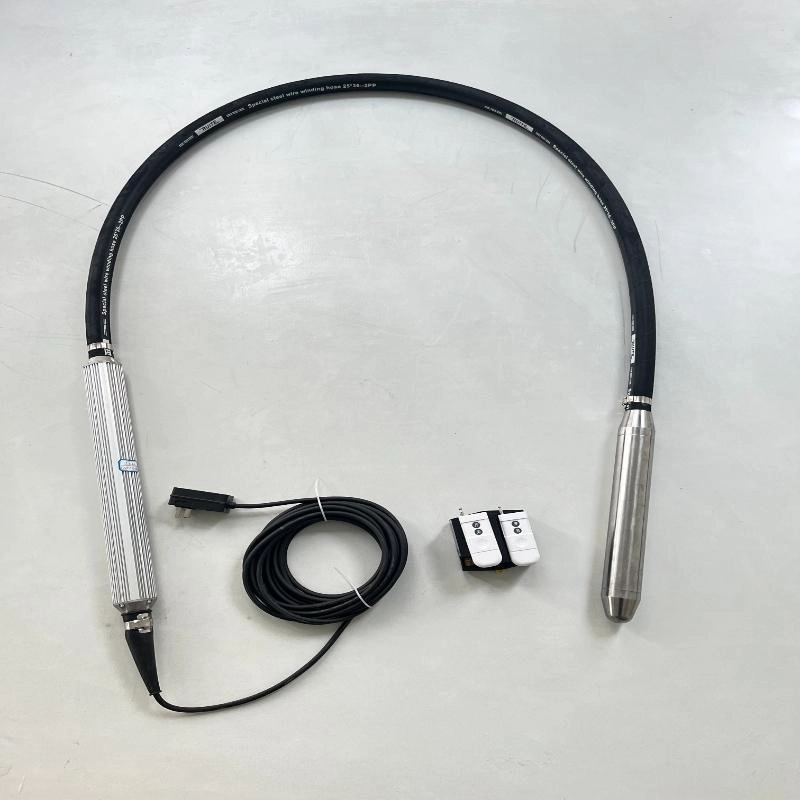
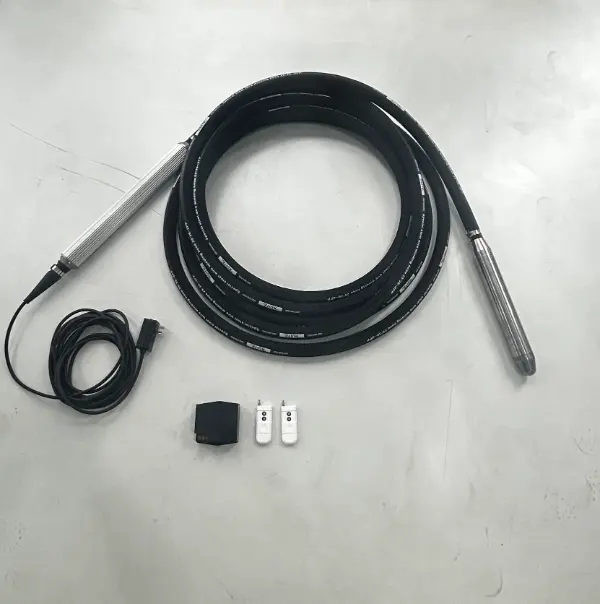
- Customized rubber tube, wear-resistant and tough, 1800 N pulling force, length 1-50m.
Product Advantages
ONNEW intelligent high-frequency concrete vibrator has the characteristics of light weight, maximum power up to 2000W, strong exciting force (5000N-5500N), large vibration radius (amplitude 1.1MM), high frequency 12000 rpm, low noise (<75 decibels), rubber tube without length limit, high efficiency, long life and not easy to get stuck.
Technical Advantages

Cost Advantage:
● The life of the vibrator is much longer than that of traditional vibrators
● Single-person operation (low labor cost)
● Can be started with high load (no need to cut the rod head!)
Advanced Transmission Method:
● More optimized excitation efficiency!
● More powerful exciting force!
● The excitation force is not affected by the length (wider usage scenarios)

Better User Experience:
● Lighter weight!
● The hose does not vibrate and protects workers
● Remote control switch, easy and convenient
● Less vibration and noise
Usage Scenarios
Whether building viaducts, railways, high-rise buildings or highways, ONNEW provides one-to-one customized services based on customer needs to meet customer requirements.
FAQ
Q1: What happens if I use a concrete vibrator to push or move wet concrete horizontally inside the formwork?
Using a vibrator as a shovel to move concrete horizontally is a severe error that causes “segregation.” Because vibrational energy affects materials of varying masses differently, attempting to flow the concrete horizontally will cause the lightweight water and fine cement paste to separate and surge forward, while the heavy gravel and coarse aggregate are left behind. This completely ruins the uniform mixture of the concrete, resulting in structural weaknesses, severe honeycombing in rocky areas, and cracking in areas with too much paste. Always use a concrete rake or shovel to place the concrete, and only use the vibrator to consolidate it vertically.
Q2: How do I determine the “radius of action” for my specific concrete vibrator?
The radius of action is the circular zone around the vibrator head where the concrete effectively liquefies and releases air. As a general rule of thumb, the radius of action is typically 4 to 8 times the diameter of the vibrator head. However, the easiest way to determine this in real-time is visual observation: when you plunge the vibrator into the mix, look at the surface of the concrete. The area that flattens out, stops bubbling, and takes on a shiny, watery sheen represents your true radius of action. Your next plunge should overlap this shiny circle by 1 to 2 inches.
Q3: Why is it necessary to plunge the vibrator deep into the previous layer when pouring in multiple lifts?
When pouring deep structures like columns or walls, concrete is poured in horizontal layers (lifts). If you only vibrate the top layer, the boundary between the old layer and the new layer will not blend together, resulting in a “cold joint.” A cold joint is a distinct, weak horizontal seam that severely compromises the structural integrity and waterproofing of the wall. By plunging the vibrator 3 to 6 inches into the underlying (but still plastic) layer, you agitate both layers simultaneously, knitting the aggregates together and creating a single, monolithic, structurally sound mass.