How to Choose the Right High-Frequency Concrete Vibrator for Your Project?
Release time: 2026-09-01
In concrete construction, the choice of a high-frequency concrete vibrator directly impacts concrete compaction, construction efficiency, and the quality of the finished structure. Since projects vary in terms of concrete slump, reinforcement density, structural dimensions, placement depth, and on-site power supply, there is no single model suitable for every scenario. For construction contractors, precast manufacturers, and equipment purchasers, it is crucial to match vibration frequency, amplitude, vibrator head size, and equipment design to the specific application. As a manufacturer specializing in high-frequency concrete vibration technology, ONNEW continuously develops smart, variable-frequency high-frequency concrete vibrators, providing professional equipment and application solutions tailored to diverse construction environments.
Table of Contents
Why are high-frequency concrete vibrators suitable for modern concrete construction?
High-frequency internal concrete vibrators transfer vibrational energy to fresh concrete at high frequencies, facilitating the release of entrapped air bubbles and enhancing concrete compaction. ACI guidelines on concrete consolidation indicate that high-frequency internal vibrators deliver excellent compaction results across a wide range of structural sizes and shapes.
For structures such as walls, columns, beams, foundations, and areas with dense reinforcement, high-frequency vibration helps the concrete flow effectively into the spaces between rebar and into the corners of formwork.
However, it is important to note that a higher frequency is not necessarily better. Actual performance depends on a combination of factors, including amplitude, vibrator head size, concrete slump, and reinforcement density.
How do you choose a vibrator based on the concrete type?
Concrete fluidity is a primary factor to consider when selecting equipment.
ACI guidelines state that a vibrator’s effective radius depends not only on the equipment itself but also on the concrete’s workability and the degree of reinforcement congestion.
| Concrete and Working Conditions | Recommended Selection Factors | Typical Applications |
|---|---|---|
| Concrete with good plasticity | High frequency and moderate amplitude | Walls, columns, beams |
| Low-slump concrete | Focus on vibration force and amplitude | Foundations, slabs, heavy-duty structures |
| Reinforced concrete with dense rebar | Smaller-diameter vibrator head and flexible operation | Reinforced concrete walls and columns |
| Mass concrete | Larger-diameter vibrator head and wider radius of action | Foundations, bridges, large structures |
| Narrow or complex working spaces | Smaller-diameter vibrator head and longer flexible shaft | Precast concrete components, thin-wall structures |
Therefore, when purchasing equipment, the vibrator head size should be selected based on the specific structure being built, rather than simply opting for the largest model available.
How should vibration frequency and amplitude be matched?
Frequency and Amplitude are critical parameters for high-frequency concrete vibrators. Frequency indicates the number of vibrations the vibrator head undergoes per unit of time, while amplitude represents the magnitude of the vibratory motion. Typically, frequency and amplitude must be matched based on the equipment design and specific concrete conditions.
For concrete with good flowability, high frequency combined with moderate amplitude generally yields superior compaction and surface finish; for stiffer concrete or mixes with low slump, the focus should be on the effective vibration force the equipment can deliver.
Therefore, when comparing products from different suppliers, it is recommended to consider the following specifications:
Vibration Frequency
Amplitude
Centrifugal Force
Vibrator Head Diameter
Effective Radius
Motor Power
Do not rely solely on motor power to evaluate vibrator performance.
How do I select the vibrator head diameter based on rebar density and construction space?
The diameter of the vibrator head directly determines the equipment’s scope of application.
If the rebar arrangement in walls, columns, or precast elements is dense, a large-diameter vibrator head may struggle to fit between the bars; in such cases, a high-frequency vibrator with a smaller diameter and greater maneuverability is preferable.
Conversely, for large-area slabs, foundations, or thick concrete structures—and provided the workspace allows—a larger-diameter vibrator head can be considered to increase the coverage area of each insertion.
The actual insertion spacing should be determined based on the equipment’s Radius of Action. Concrete consolidation guidelines recommend ensuring some overlap in the vibration zones between adjacent insertion points, rather than simply spacing them at fixed intervals.
What else should be considered when purchasing high-frequency concrete vibrators for a project?
Beyond technical specifications, it is essential to consider the equipment’s suitability for long-term on-site use.
When purchasing, pay particular attention to the following:
① Power Supply
Select the appropriate voltage, power frequency, and motor configuration based on site conditions.
② Flexible Shaft Length
For deep foundations, walls, and complex formwork structures, choose a flexible shaft length that matches the required construction depth.
③ Continuous Operation Capability
If the equipment is intended for heavy-duty use, prioritize the durability of the motor (specifically heat dissipation), bearings, flexible shaft, and vibrator head.
④ Ease of Operation
Equipment weight, the flexibility of the flexible shaft, and handle design all impact the operational efficiency of construction personnel.
⑤ Maintenance and Spare Parts
For B2B project procurement, it is also essential to verify the availability of wear parts, maintenance support, and the supply chain for spare parts in advance.
How do you quickly select the right high-frequency concrete vibrator?
If you are sourcing high-frequency concrete vibrators for a specific project, you can evaluate your needs in the following order:
Project type → Concrete slump → Rebar density → Structural thickness → Construction space → Vibrator head diameter → Frequency/Amplitude → Power source → Operating duration → Maintenance requirements.
This selection method is more reliable than simply comparing “power ratings.”
Selecting the right high-frequency concrete vibrator requires a comprehensive assessment—considering concrete properties, rebar density, construction space, vibrator head size, amplitude, effective radius, and on-site power conditions—rather than just comparing power output or vibration frequency. Matching the right equipment to the specific project helps construction teams improve concrete consolidation efficiency and minimizes construction issues caused by improper equipment selection.
Why Choose ONNEW?
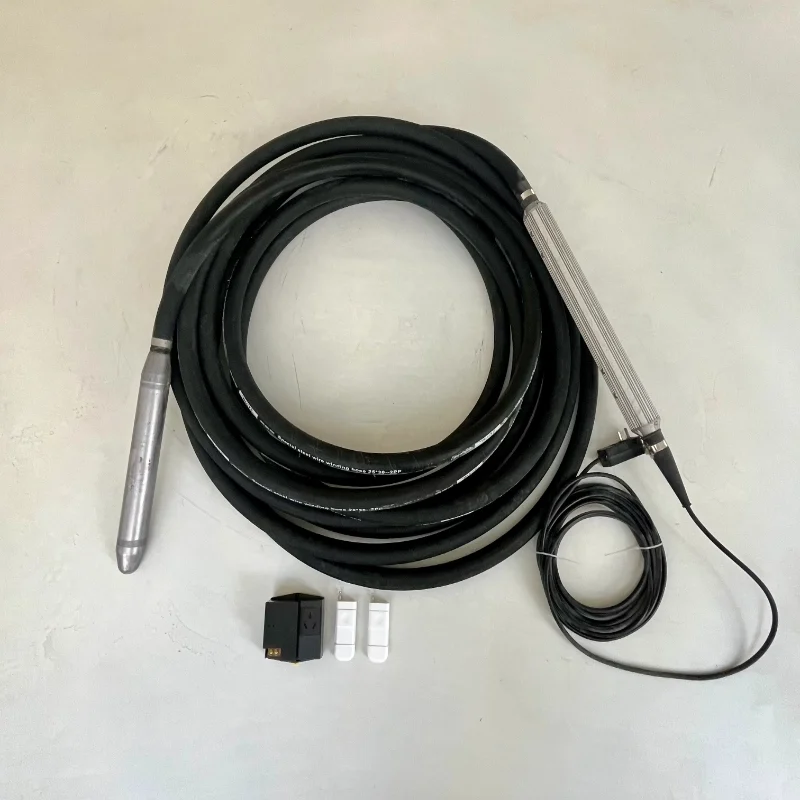
ONNEW is a specialized equipment supplier focused on the R&D and manufacturing of high-frequency concrete vibration technology. With over 20 years of technical expertise, the company independently develops intelligent variable-frequency high-frequency concrete vibrators. Its products feature a design where the motor is built directly into the vibrator head, eliminating the operational limitations associated with traditional external motors and flexible shaft drive systems; the company also offers various length configurations and customized solutions to meet diverse engineering needs.
For overseas contractors, precast concrete manufacturers, construction equipment distributors, and OEM clients, ONNEW provides not only standardized high-frequency concrete vibration equipment but also tailored product configurations and technical support based on project-specific factors such as operating distance, power standards, and application conditions. Some of its high-frequency vibrators achieve speeds of up to 12,000 VPM and offer a range of hose lengths to suit various construction environments. If you are looking for high-frequency concrete vibrators for a specific project, we recommend providing ONNEW with details such as the concrete type, structural dimensions, rebar density, placement depth, and on-site power supply before making a purchase. Our professional team can then assist in selecting the right equipment based on actual site conditions, ensuring a vibration solution perfectly tailored to your concrete construction needs.