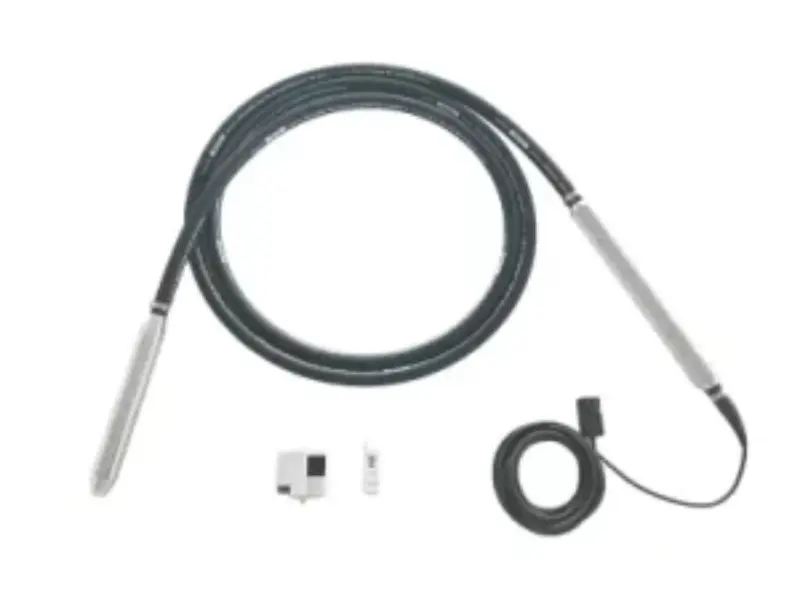
How to Choose the Right Concrete Vibrator Frequency for High-Strength Mixes?
Release time: 2026-03-06
Table of Contents
High-strength concrete mixes are engineered for exceptional durability, load-bearing capacity, and structural integrity, making them the absolute standard for modern infrastructure such as high-rise buildings, railways, and viaducts. However, the very characteristics that make these mixes superior—such as low water-to-cement ratios and high viscosity—also make them notoriously difficult to place and consolidate.
Proper consolidation is non-negotiable in civil engineering. Inadequate vibration leaves honeycombs, cold joints, and entrapped air voids that can severely compromise the structural integrity of the final build. The secret to a flawless, highly dense placement lies in selecting the right internal concrete vibrator, and specifically, focusing on the optimal concrete vibrator frequency.
Understanding the Mechanics: Amplitude vs. Frequency in Concrete Consolidation
To make an informed decision, contractors and site managers must understand the synergistic relationship between frequency and amplitude. Frequency, typically measured in vibrations per minute (vpm) or revolutions per minute (rpm), refers to how fast the vibrator head oscillates. Amplitude, on the other hand, is the maximum distance the head travels off its axis during each cycle.
For standard concrete with a high slump, standard frequencies might suffice. However, high-strength, low-slump mixes demand a highly specialized approach. When dealing with these stiff materials, a high frequency concrete vibrator is indispensable. The high frequency directly targets the fine aggregates and the cement paste, rapidly reducing internal friction. This process temporarily liquefies the mortar, allowing the heavier coarse aggregates to settle tightly into a dense matrix while simultaneously forcing trapped, structural-weakening air bubbles to the surface.
The 12,000 RPM Benchmark: The Role of High Frequency
Industry best practices and rigorous engineering testing dictate that for high-strength concrete, a frequency of around 12,000 rpm is optimal. At this exact speed, the vibrator provides enough kinetic energy to move the stiff paste without causing the segregation of the aggregates.
Lower frequencies often fail to break the surface tension of the dense paste, leaving dangerous voids around dense rebar grids. Conversely, equipment that operates precisely at 12,000 rpm ensures rapid de-aeration. This high-speed oscillation is vital when pouring heavily reinforced structures. The effectively liquefied concrete can easily flow through complex, highly restrictive rebar configurations without causing the equipment to jam or the aggregate to clump.
Key Factors When Selecting a Concrete Vibrator for High-Strength Mixes
Choosing the right intelligent concrete vibrator involves looking far beyond just the RPM. You must evaluate a holistic set of specifications to match the rigorous demands of your construction site.
1. Exciting Force and Peak Power
High-strength mixes require immense force to move. You must look for equipment delivering peak power up to 2000W and a robust exciting force in the range of 5000N to 5500N. This massive power output ensures the vibrator does not bog down, stall, or lose RPM when fully submerged in dense, heavy concrete.
2. Vibration Radius and Head Design
The area of influence—or vibration radius—is critical for on-site efficiency. A wear-resistant, alloy steel or stainless steel head (ideally around 50mm in diameter) generating a large vibration radius with an amplitude of 1.1mm maximizes the volume of concrete consolidated per insertion. Furthermore, a streamlined, slot-free configuration is mandatory; it prevents the head from getting trapped in reinforcing steel, ensuring a smoother extraction.
3. Advanced Motor Technology
Traditional mechanical vibrators suffer from rapid wear, frequent breakdowns, and sudden power drops. For modern high-strength mixes, opt for equipment utilizing a built-in permanent magnet synchronous inverter motor. This intelligent variable frequency technology ensures consistent output regardless of the load. Most importantly, it allows the equipment to be started directly under high-load conditions (while already submerged in concrete) without the need to cut the rod head.
4. Hose Length and Durability
The physical environment of the pour dictates the physical requirements of your equipment. Traditional vibrators are restricted by mechanical shafts that lose power over distance. Modern high-frequency systems maintain their excitation force regardless of the hose length, utilizing advanced electrical transmission. A customized, high-strength lightweight rubber tube capable of withstanding 1800 N of pulling force allows operators to navigate deep forms safely.
Overcoming Rebar Congestion with Intelligent Vibration
High-strength concrete is almost exclusively used in structures with dense, heavily engineered reinforcing steel grids. This presents a unique challenge: navigating the vibrator head through tight spaces without causing damage. An intelligent high frequency concrete vibrator excels in this environment. Because the motor is located directly within the head, the traditional bulky, spinning mechanical flexible shaft is eliminated.
The lack of moving mechanical parts in the hose means the vibration is localized exactly where it is needed—in the concrete—rather than traveling up the hose to the operator’s hands. This precise energy transfer allows the 1.1mm amplitude to work efficiently, pushing the coarse aggregate away from the vibrator head while pulling the cement paste inward to coat the rebar perfectly, resulting in an unyielding bond between steel and concrete.
Acoustics, Ergonomics, and Site Safety
Another frequently overlooked factor when selecting a high-frequency internal concrete vibrator is the acoustic impact and ergonomics. High-strength concrete pours in urban environments require stringent noise control. State-of-the-art intelligent vibrators are engineered for low-noise operation, typically generating less than 75 decibels.
Additionally, because the hose does not vibrate, workers are protected from Hand-Arm Vibration Syndrome (HAVS). Combined with lightweight designs intended for single-person operation and remote control switches, modern vibrators drastically reduce labor costs while maximizing worker safety and comfort.
Elevate Your Concrete Consolidation with ONNEW
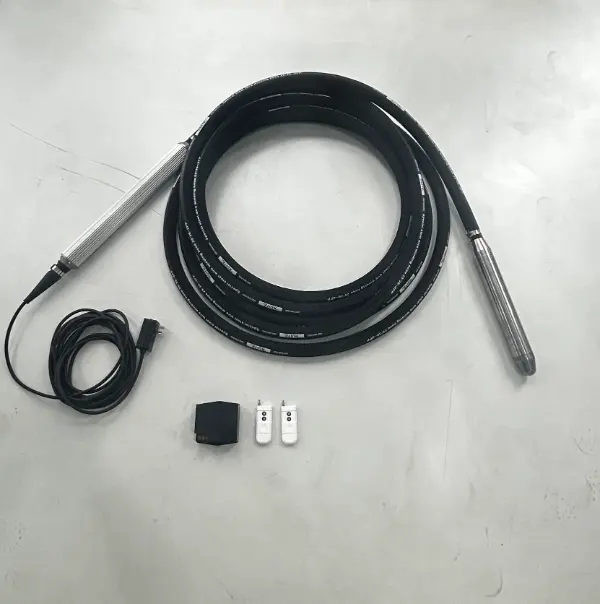
Backed by over 20 years of dedicated technological accumulation, ONNEW is a premier global manufacturer of the intelligent high frequency concrete vibrator. We adhere to the purpose of continuous innovation, providing high-quality, professional solutions at preferential prices. Designed for efficient single-person operation, our flagship vibrator boasts a lightweight profile, a peak power of 2000W, and a formidable exciting force of 5000N-5500N. Operating at an optimal 12000 rpm with a 1.1mm amplitude, it effortlessly consolidates the stiffest high-strength mixes. Our advanced permanent magnet synchronous inverter motor guarantees smooth, high-load starts and an exceptionally long lifespan. The wear-resistant 50mm stainless steel head features a streamlined configuration, ensuring it never catches on rebar. Furthermore, our highly durable, non-vibrating rubber tubes withstand 1800 N of pulling force and can be customized from 1 to 50 meters to perfectly suit railways, high-rises, or viaducts. Partner with ONNEW for European-standard quality, localized voltage support, and highly cost-effective construction solutions.


FAQ
1. What is the difference between a standard vibrator and a high frequency concrete vibrator?
Standard vibrators usually rely on mechanical shafts and operate at lower frequencies (around 8,000 to 10,000 vpm), which can struggle with stiff mixes. A high frequency concrete vibrator utilizes inverter motor technology inside the head to operate at elevated speeds (like 12,000 rpm). This allows for superior liquefaction of high-strength concrete, unlimited hose lengths without power loss, and a non-vibrating hose that protects the operator.
2. Can the ONNEW concrete vibrator start while fully submerged in a high-strength mix?
Yes. Unlike traditional models that require the operator to turn the equipment on in the air before plunging it in, an intelligent high frequency concrete vibrator equipped with a permanent magnet synchronous motor allows for high-load starts. You do not need to cut the rod head; it will power up seamlessly even when fully immersed in dense, heavy concrete.
3. How does hose length affect the vibration power of an intelligent concrete vibrator?
With traditional mechanical vibrators, longer hoses lead to a significant drop in excitation force due to friction within the inner core. However, intelligent high-frequency vibrators utilize advanced electrical transmission. Because the motor is in the head, the excitation force is completely unaffected by the length of the rubber tube, allowing ONNEW to provide customized lengths up to 50 meters without any loss of vibration performance.